Thursday, 30 January 2014

A group of reviews for TheGayUK

I haven't added much to my blog recently, so thought I'd group together here some of my recent reviews for TheGayUK.


The two DVDs that came through my letterbox just after Christmas could not be more different, though both come from our friends over at Matchbox Films.


The first of the two I watched was Having You, written and directed by Sam Hoare. There are some great performances here, from Andrew Buchan as recovering alcoholic Jack, from Philip Davis as his thoroughly nasty and unlikeable father, from Romola Garai, as Jack’s beautiful girlfriend, from the gorgeous Steven Cree as Jack’s business partner and sponsor, and from the ever watchable Anna Friel as Anna, a blast from the past who drops a bombshell on Jack that he finds difficult to come to terms with. 

It’s a gentle, watchable movie, which draws you in, but I confess to finding it somewhat manipulative with an ending that is just a little too pat to be convincing. None the less, worth catching if you have a couple of hours to spare one evening.
***


Director Beth B brings us Exposed: Beyond Burlesque, an expose of the ‘new’ burlesque scene, which seeks to challenge traditional ideas of body, gender and sexuality. A mixture of interviews, glimpses backstage and filmed performances, we are introduced to an engaging group of individuals, who might also, in other circumstances, be called misfits. According to Mat Fraser, an English performer with phocomelia of both arms due to his mother being prescribed thalidomide during her pregnancy, burlesque is an honest and sometimes brutal art form. It can also be extremely vulgar, which is I suppose the point. There is a lot of naked flesh on show, though very little in the way of titillation. Maybe, to fully experience the power of these acts, one has to be in the audience, but most of the interest really comes from the interviews, and the performers’ often quirky view of life; at its heart a touching little love story between Mat Fraser and Julie Atlas Muz. Truth to tell, it is a little long and could have done with some judicious pruning. I found my mind wandering quite a bit after the first hour.
***
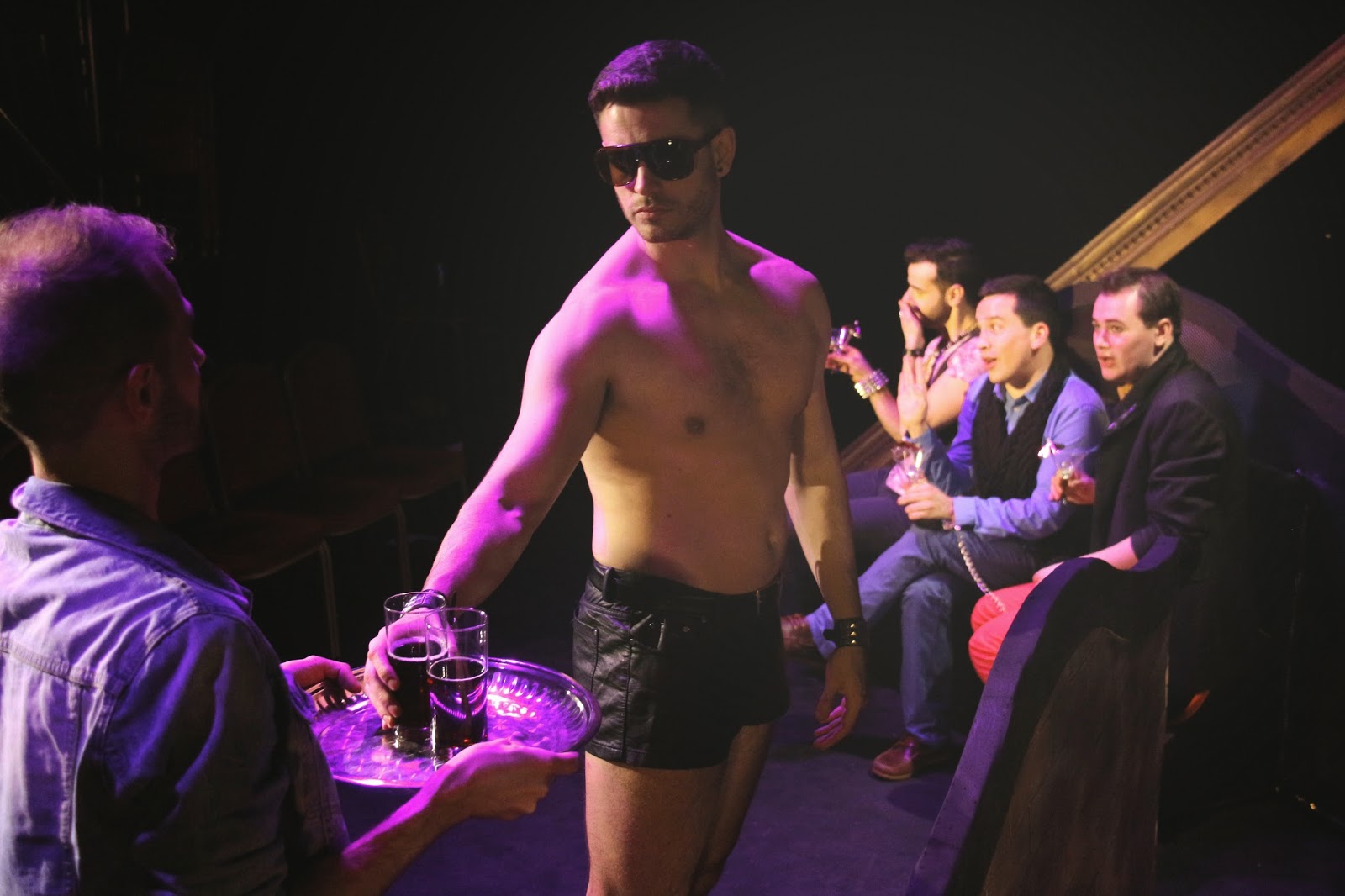
Matthew Ferdenzi in The Gay Naked Play


In The Gay Naked Play, currently at the Above The Stag Theatre in Vauxhall, Dan (Alexander Hulme) is director of the Integrity Players, a small off off Broadway group of players dedicated to “great art”. The company also consists of his loving (and very pregnant) wife Amanda (Stacy Sobieski) and their friend and leading actor Harold (Lucas Livesey). They have lofty ambitions and a staunch refusal to compromise , but they have one problem. Tiny audiences. And when their sole and major backer, who just happens to be Amanda’s Machiavellian mother Imelda (Ellen Verenieks) withdraws her support, they have an even greater problem. No money. What are they going to do?

Enter Eddie Rossini (Christopher Woodley) and his two cronies, T.Scott (Robert Hannouch) and Edonis (Toby Joyce). Eddie proposes a trashy homoerotic stage version of Mel Gibson’s “The Passion of Christ” starring porn star Kit Swagger (Matthew Ferdenzi). It’s a sure fire commercial hit, but will the Integrity Players give in to financial pressure and in so doing lose their integrity? I’m not going to give the game away, but I think we can all guess the answer to that one.

Adam Bell’s play is a witty and often hilarious comment on the eternal conundrum of artistic compromise; popularity versus art. The writing itself is often really clever, abounding in quips and one-liners that wouldn’t have been out of place in an episode of Will and Grace. 

My problem was more with the execution. Director Andrew Beckett has allowed too much of the play to be played on one level, with actors shamelessly mugging and playing too many of their lines out front. The often hilarious antics of T.Scott and Edonis would have benefited from a greater contrast with their boss, Rossini, but he too was encouraged to overplay much of the comedy, which resulted in a lack of contrast. Surely underplaying the role would have made it even funnier. It’s a shame, because the play is a lot of fun, and I feel sure that this cast had it in them to deliver a much more multi-faceted performance.

That said, the audience on opening night enjoyed themselves enormously, and nobody was complaining about Matthew Ferdenzi getting his kit off more than once. Maybe it will settle down a bit in the next few performances.
***


Free Fall (or Freier Fall, to give it its German title) is an award winning drama from director Stephen Lacant. It has been branded a sort of German Brokeback Mountain, and indeed there are parallels between the two movies, but in some ways Free Fall is more gritty, more rooted in the present day.
Marc would seem to have his life sorted out. He’s doing well in the police force, his girlfriend is having a baby, and they have just moved into a house, next door to Marc’s parents. He is happy (or he thinks he is) and everything is going well for him. He meets Kay at a training camp and the two men become attracted to each other.  Though Marc tries hard to fight his feelings, he later starts a relationship with Kay and subsequently finds his life spiralling out of control. 

I suppose the basic storyline has a certain resemblance to Brokeback Mountain, but there the similarities end. Whereas in Brokeback much of the romance is played out against the magnificent scenery of Wyoming, this relationship is much more claustrophobic, harder to hide as so much of their life is in plain view; not much chance for the men to get away from their colleagues and Marc’s family.

Ultimately the movie is not just about Marc’s coming to terms with his homosexuality, it is more about whether he will allow himself the freedom to walk away from the life that has been set out for him by his parents, his colleagues and his girlfriend. Marc finds it impossible to choose between Bettina and Kay because he can’t decide between the two lives they represent, between comfortable domesticity on the one hand, and freedom, with all the danger and unpredictability that suggests, on the other.

Ultimately that choice is made for him, and though we do not know how life will pan out for Marc, there is a suggestion that he will eventually break free.

With superb performances from the two central actors, Hanno Koffler as Marc and Max Riemelt as Kay, not to mention Katharina Schuttler as Marc’s girlfriend Bettina, it is an engaging and involving movie, beautifully filmed and subtly played out. Lacant directs with a sure hand which is honest and true. Recommended.
****


Thursday, 2 January 2014

My Best of 2013

Much of the latter part of this year has been taken up with reviews for www.thegayuk.com so I've elected to finish 2013 with a list of my ten best of the year.

A Chorus Line


Sadly, my first choice only managed a run of a few months at the London Palladium, nor is it a show I reviewed myself. The original Broadway production of A Chorus Line opened in 1975 and ran for 6,137 performances, garnering  no less than 12 Tony Awards. It was the longest running musical in Broadway history, until overtaken by Cats in 1997. Here in London it managed a respectable 3 year run, when it opened at the enormous Theatre Royal, Drury Lane in 1976. The Palladium revival was a loving re-creation of the original, using Michael Bennett’s original choreography (Bennett died in 1987 of AIDS related lymphoma), and it brought back many memories of when I was a young dancer, working in the West End. This revival was every bit as brilliant as the original production and various reasons were offered as to why it was not as huge a success this time round. Apparently it had minority interest (only dancers and people in show business could have any interest in the travails of being a Broadway/West End hoofer); at 90 minutes without an interval, it was too long and attention flagged; it lacked spectacle being set, for the most part, on an empty stage with dancers in practice clothes. But this was all true the first time round, and the show was a huge success back then. Audiences have changed, I suppose. Certainly the second time I attended this revival (on press night) the audience seemed more interested in being seen themselves than watching the show.

Once

I did review my next musical of choice, and am happy to report that it is still running at the Phoenix Theatre, and absolutely demands to be seen. Once was originally a charming indie film, which has been expanded and fleshed out to make a full evening at the theatre. The stage of the Phoenix has been decked out to look like an Irish pub, where members of the audience can enjoy a drink before the show and during the interval. Almost imperceptibly the show starts, while the audience are still making their way to their seats. Not really a musical in any conventional sense, it is original, charming, sublimely poetic, moving, eloquent, and stylish. Don’t miss it.


Of my next three choices, only one is still running in the West End, though the Menier Theatre production of Sondheim’s Merrily We Roll Along enjoyed a new lease of life when the production was filmed and shown in cinemas up and down the country. Maybe it will eventually also get a DVD release. It has always been one of my favourite Sondheim shows, though its rather cynical message found little favour among audiences when it was first produced back in 1981, when it ran for 44 previews and only 16 performances. At least Maria Friedman’s debut production for the Menier Theatre did a lot better than that. Given a slightly more upbeat twist by Friedman and via a few deft re-writes by Sondheim, and with some fabulous performances (particularly Jenna Russell as Mary and Damian Humbley as Charlie) this was a sure-fire hit.


Not to be missed was Jamie Lloyd’s revival of Alexi Kayle Campbell’s superb The Pride at the Trafalgar Studos. This superb play that juxtaposes two parallel love stories, one from the 1950s and one from today, deftly reminds us that prejudice is still here, despite the strides we have made in recent years. With fantastic performances all round, this was an extremely memorable night in the theatre.


Still running (though the Apollo has been closed for a while after part of the ceiling collapsed a couple of weeks ago) is the National Theatre’s production of The Curious Incident of the Dog in the Night-Time. Wonderfully inventive, superbly theatrical, this adaptation of Mark Haddon’s popular novel will no doubt run for years. We were fortunate enough to book our tickets a few days before the production won no less than 7 Olivier awards, as it sold out completely after that. I’m sure it’ll be around for quite a while yet though.


Andrew Lloyd Webber and Time Rice are back in the West End this year, though not working together this time. Lloyd Webber ‘s new musical Stephen Ward is at present previewing at the Aldwych and Time Rice’s musical version of From Here To Eternity (with music by Stuart Brayson) opened at the Shaftesbury Theatre in October. In many ways a reassuringly old fashioned musical (it is not sung through and has a very strong libretto by Bill Oakes), it is a thoroughly enjoyable, brilliantly conceived and executed new show. Let’s hope it has a deservedly long run.


In the cinema, I got the chance to review HBO’s Behind the Candelabra, made for TV, but here given a theatrical release. Stephen Soderbegh’s direction is not always sure footed, and the film drags a little in the middle, which might be less noticeable in the context of a TV movie. He does however get wonderful performances out of his all star cast. Aside from Rob Lowe’s  brilliantly immobile plastic surgeon, there are some great cameos from Dan Ackroyd, Scott Bakula and Debbie Reynolds (remember her?), but the movie succeeds or fails on the work of its two stars, and both Michael Douglas and Matt Damon give faultless performances. Damon is thoroughly believable as the star struck young innocent who gradually descends into drug addiction, and Michael Douglas quite simply gives one of the best performances of his career. It would have been so easy, and so tempting, to overplay the role and come up with a clownish caricature, but Douglas completely avoids that trap, and comes up with a performance of great subtlety, which deservedly won him an Emmy Award.


I didn’t review I Want Your Love which was granted a limited cinema release in the UK. Given the amount of explicit sex in the film, this is hardly surprising. Like Shortbus before it, director Travis Matthews breaks new bounds in how to present sex on the screen. The sex, and there is a lot of it, is real, and we get to see everything; blow jobs, penetration, cum shots, the lot. What makes it different from your bog standard porn movie is that this features real actors, and very good ones at that, pushing the boundaries of what they will do on screen in the context of a role. The sex scenes are handled rather differently than they would be in a porno, and much more sensitively; the connection between the actors, the reactions on their faces rather more important than the sex itself, though the camera doesn’t shy away from that either. There’s not a lot of plot, so it certainly doesn’t keep you on the edge of the seat wondering what will happen next. It’s one of those movies in which people spend a lot of time talking to each other; about their feelings, about their relationships, about work. I found it totally immersing and involving.

How To Survive A Plague - Peter Staley

Though I understand that many will not respond to I Want Your Love as I did, I do recommend unreservedly David France’s masterly documentary How To Survive A Plague. This remarkable movie tells the story of a small group of men and women in America, most of them HIV positive, who battled against government indifference and departmental incompetence, to save their own lives. In so doing they helped save the lives of 6.000,000. Gripping, moving, inspiring, at times emotionally draining, it is a story that demands to be told. Required viewing for every gay man, particularly those under the age of 30.

Don't Ever Wipe Tears Without Gloves


And finally to a great piece of television, shown just this last month on BBC4. Don’t Ever Wipe Tears Without Gloves is an award winning Swedish three parter, based on novelist Jonas Gardell’s trilogy about the impact of AIDS on the gay community in Sweden in the early 1980s. Subtly and sensitively acted, and beautifully filmed, this was great television, the last of its three episodes almost unbearably moving, so much so that I watched it through a film of tears. If you missed its network TV showing, then do not hesitate to buy it on DVD, but make sure you have a box of tissues at the ready.


Sunday, 17 November 2013

It's ok to be different, isn't it?

This article first appeared in www.thegayuk.com on Thursday 21/9/2013, National Stand Up Day


My school days are such a long time ago now that I barely remember them, or is it that I just blotted them out?  They seem to belong to a different person who has absolutely nothing to do with the person I am now. I had no idea I would turn out to be gay, though anyone with half a brain could probably have figured it out. I was dancing (in my pram) before I could walk, singing perfectly in tune before I had the slightest idea what I was singing about (all lyrics reduced to lalala), and my favourite films were those involving plenty of song and dance, Fred and Ginger in particular. From an early age, all I wanted to do was dance.

This always singled me out as being a little different, but my earliest days at primary school were surprisingly happy. It was a mixed school and the other boys didn’t seem to mind that I preferred hanging out with the girls and not playing football with them. Well, they probably reasoned, at least they were spared having to pick me to be in their team. My school was in the middle of a highly middle class part of my home town, and the other pupils all came from the same area. Our parents all knew each other. It was a safe and cosy environment. Even so, though I don’t ever remember feeling physically threatened at my primary school, I had to learn to toss off the occasional jibes about being a sissy and a big girl. However in my last year or two, when I was sitting my eleven plus and preparing to go either to an all-boys Grammar School if I passed, or an all-boys Public School if I didn’t, I started to be picked on that bit more. School was not the fun place it had been when I was younger.

I had been taking tap dancing lessons since I was five and would constantly sail through my various exams. Dancing was not a boy’s pursuit though. The penny dropped when I looked around at one of the annual dance school displays and realised I was the only boy on stage. That was probably behind my decision to give up dancing lessons. l My dancing teacher, a friend of the family whom I knew as Auntie Joy, was pressing my mother and father to get me to start ballet. She had been a professional ballet dancer herself and an Honours Associate of the Royal Academy of Dance. She thought that, physically, I had the perfect proportions to be a ballet dancer. However, no amount of cajoling on the part of my parents was to make me change my mind. I had decided that there was no way I was going to be going to ballet class when I got to my next school, and, it has to be admitted, my parents didn’t try that hard to persuade me otherwise. It had been bad enough been singled out for going to tap dancing lessons. I was hardly going to make things worse for myself by doing ballet.

Secondary school (the local grammar) was to prove a terrible culture shock. It was my first exposure to boys from the other side of town, boys who were bright enough to pass their eleven plus, some of whom lived on council estates, and who had built up their own set of tools to deal with the harsher environment they came from. Grammar School was pretty egalitarian in that respect. Boys attending came from all over the town, not one single catchment area.  No doubt to many of them, it appeared I had a privileged existence, and in some ways I had. We holidayed in Greece (staying with my grandparents there) when air travel was only for the rich; my father ran his own business and drove a Jaguar. This was enough to single me out, but it probably didn’t help that, though I no longer went to dance classes, I maintained a keen interest in theatre and dance, and would often participate in local operatic society productions, for which my father was musical director. No doubt, all this would have been forgotten if I’d been a keen football player or rugby player, but I had absolutely no interest in sport. At primary school I had made friends with all the girls. Here there were no girls. I found it hard to make friends and I became an easy target. Nobody actually called me gay (well the word didn’t exist back then), but I was called a sissy and a poof, without any of us really understanding what that meant. You have to remember homosexuality was illegal in those days. There was no way I was going to admit to myself, let alone anyone else, that I was gay, and I still assumed that I would meet a girl, get married and have children. I knew virtually nothing about sex. Children were much more innocent in those days. Still the other boys sensed I was different, and this is what separated me from them.
I wasn’t the only boy to be bullied and ostracised though. There were others, who found it harder to get on than me, and I briefly befriended some of them, though ignominiously dumped them when I realised that being friends with them was doing me no good whatsoever.  I remember one boy committed suicide while I was there. He was an odd, skinny, intellectual boy, with National Health glasses held together with Elastoplast, evidently from a poor family. Nobody would have anything to do with him, and even the teachers teased him. When he died, there was an announcement in assembly, but the whole sorry business was glossed over. There was never any attempt to tackle bullying in the school, and, truth to tell, the teachers often colluded in it, the idea being that a certain amount of bullying was good for the softer kids, that it was character building.

 My elder brother had gone to the same school 4 years before me, and, though we fought like cat and dog at home, he was to prove to be my protector in my early years at Grammar school. He couldn’t be there all the time of course, but at least I had his protection on the walk home from school, and more than once he turned on boys who were calling me names. I don’t know how I’d have coped without him. I wouldn’t have known how to fight back and, other than my brother, my only defence was speed. I could outrun most of the boys in my year, a fact that was first brought home to me on the day we had some athletics tests. To the amazement of all the other boys, who had assumed all sissy boys were useless at sport, I came first in my year in the 100 and 220 (yards, not metres in those days) and also tested well in the long jump. My games master encouraged me to join the athletics team, but I flatly refused, not because I didn’t enjoy running and jumping, but because I didn’t want to spend any more time than I had to with boys who bullied and threatened me. So, for the second time, I didn’t do something I was good at out of fear, out of fear for what the other boys would do to me. I had earned a somewhat grudging respect because I could run, so the physical bullying stopped, but the verbal jibes continued. I was a sensitive child and it hurt. It’s taken me a long time to learn to ignore people who seek to hurt with words. Indeed the scars can take a lifetime to heal.


The only place I felt safe was in music classes, and my viola teacher, who knew how horrific games lessons were for me, ended up programming my viola lessons at the same time as the games periods, telling the headmaster there were no other slots available. I was eternally grateful to him. A kind, gentle, quietly spoken man, with weirdly wax like hands and fingers, I have no doubt that, though married, he was gay, not that I knew or guessed that at the time, but looking back, it seems plausible enough. I’m sure he recognised a kindred spirit. Still, in a more accepting environment, maybe I would not have accepted his offer of programming my viola classes so I could skip games. I admit I rather regret not participating in sport at school now. To this day, I feel a mild sense of panic when someone throws a ball at me, or puts a bat in my hand. I feel I’ve missed out.

When my brother went to university, I had to find a way to survive without him. I did so by if not actually mixing with the bad boys in school, by allying myself with them. I started smoking, let it be believed that I had a string of girlfriends. I’d buy girlie magazines like Mayfair, and make sure the other boys got to see them, though, in all honesty, nothing in their pages really did much for me. Still, they had the desired effect.  I started bunking off school too. Suddenly I was cool and the bullying stopped.

But of course I wasn’t cool. My schoolwork started to suffer. Much to the mortification of my parents, I was hauled up in front of the headmaster on more than one occasion. Though I managed to pass 6 out of 7 of my ‘O’ levels (we took a maximum of 7 in those days), I didn’t get the grades I should have done. I went from being one of the top three boys in my class to one of the bottom few. My ‘A’ level results were even worse, and I ended up having to go to a college to re-study and re-sit my English and French, in an attempt to improve my grades.

I suppose I was luckier than many. I never actually got beaten up (because I could runs so fast), and most of what I had to deal with was just words. Just words? I remember shouting back at my tormentors, “Sticks and stones can hurt my bones, but words can never hurt me.” But it wasn’t true. Words can and do hurt. They hurt me; both emotionally at the time and also in stopping me doing things I was good at and should have enjoyed. I don’t know if I’d ever have been a great ballet dancer or a great sprinter, but the point is I never got to find out, nor did I find my true academic potential. Hell-bent on survival, education was all but forgotten. How many other young people are not doing well at school because of bullying and peer pressure? I have no doubt it is thousands. We hear of the tragic cases, of those , like that young boy at my school, who are driven to take their own lives, and that one young person should feel death is the only way out is reason enough to ensure we, as adults, do everything in our power to stop another child taking their own life. We should also be considering the wider implications of children not reaching their full potential because of the way they are treated by their peers at school. Children feel that they need to fit in, and respond easily to peer pressure. What we need to do is celebrate diversity. We still live in a culture where the boy who is good at football is going to be feted and revered, whilst the boy who is good at ballet is more likely to be ridiculed and called names. We need to tell children that you can be different and still fit in, but until we can celebrate diversity in the adult world, how can we hope to make things better for children?


Thursday, 10 October 2013

Olympic Shame


So the IOC is “fully satisfied” that Russia’s anti-gay law doesn’t violate the Olympic Charter. Principle 6  of the Charter says: "Any form of discrimination with regard to a country or a person on grounds of race, religion, politics, gender or otherwise is incompatible with belonging to the Olympic Movement."  Sexuality isn’t mentioned specifically (though, in the light of recent events, it seems clear to me that it should be), but it is surely understood within the term “otherwise”. However, according to Jean-Claude Killy, chairman of the IOC Coordination Commission for Sochi 2014, this only applies to Olympic territory, not to the country as a whole. He is satisfied that there will be no discrimination of any kind in the Olympic village, and adds that the IOC doesn't really have the right to discuss the laws in the country where the Olympic Games are organised. Does this also apply then to any other country with human rights transgressions? If that is the case, can we see a time when the Olympics are taken to Zimbabwe for instance?

As it happens, the IOC don’t quite seem to believe the assurances themselves, as they are already warning athletes that any support for LGBT issues will be seen as political, and any athlete using the Games for political demonstration will be punished accordingly. The message that seems to be coming across here is that it is ok for Russia to discriminate against LGBT people, but not ok for anyone to speak up about it. Athletes are being advised to keep a low profile, deny who they are, if they are gay. This being the case, surely that would mean a legally married gay athlete might win a medal, but would not be allowed to publicly celebrate that event with their husband or wife because that would be against Russian law. Is that what you are saying, Mr Killy? I’m just asking for a little clarity on the issue, because clarity is something that has been sadly lacking. The only thing that seems clear is that the IOC will do anything to appease Putin and the Russians, and very little to stand up for LGBT rights.


At the recent U.S. Olympic Media summit in Park City, Utah, the US Olympic Committee had briefed athletes, telling them to stick to talk of sport and duck any issues regarding the Russian anti-gay law. Bravely Olympic gold medallist, skier Bode Miller, refused to be silenced. The IOC’s rules prohibit athletes from making political demonstrations at Games sites, but he took it as an opportunity to speak out about the duplicity that exists in sport.  “There are politics in sports and athletics, and they’re always intertwined,” Miller said. “Even though people try to keep them separate, or try to act like they’re separate, I think asking athletes to go somewhere and compete and be a representative of a philosophy and all that different crap that kind of goes along with it, and then tell them they can’t express their views or they can’t say what they believe, I think is pretty hypocritical and unfair. But, you know the fact is, crappy situations like that have been happening for a long time. I think it’s absolutely embarrassing that there’s countries, there’s people, that are intolerant, that are ignorant.”

That, of course, is the nub of it. The IOC, and political leaders in the West constantly talk about keeping politics out of sport, but sport is political. I have no doubt that Putin sees the Olympics in terms of politics. There was a time, after the fall of the Berlin wall, when Russia was losing its place on the world stage, and Putin has been intent on winning that back by whatever means necessary. The Olympics will be a chance for him to show off Russian wealth and power, and he is using them in exactly the same way Hitler used the Berlin Olympics back in 1936. The IOC chose then to ignore all warnings about what was happening to Jews in Germany, and look what happened. In hindsight that might have seemed inexcusable, but it was much easier to ignore the warnings back then, much harder to find the evidence. Now it is not. The internet has seen to it that, try as they might, the Russians can’t hide what is going on in their own country, but, surprisingly, or maybe not, depending on how you view the IOC, officials are still ignoring all reports of the violence being perpetrated towards LGBT people, most of it silently condoned by the police and the Russian government. And, let’s face it, whatever happens within the Olympic village, there have already been veiled threats from Russian officials that, outside it, the new law will be vigorously enforced.  The only advice that seems to be coming from the IOC is to keep a low profile and go back into the closet.

 In other words, the IOC has totally failed to comprehend the scale of the problem in Russia, no doubt because of the inherent homophobia that still exists in sport as a whole. Come on, you can’t tell me that, out of the over 2000 athletes who competed in London in 2012, only 23 were gay. The reason there were only 23 is because the majority of LGBT sportsmen and women fear discrimination and ostracism from within their own ranks, and until that is addressed then I doubt very much will change.

 However, it is not only LGBT rights that are in question in Russia. Not so very long ago, two members of the girl group Pussy Riot were given prison sentences for daring to stage a protest against Putin. One of the women, Nadezhda Tolokonnikova, went on hunger strike in prison to protest lengthy work shifts, miserable payment for work, and the existence of illegal prison disciplinarian groups made up of inmates loyal to the administration, complaints held up by Members of Russia’s Presidential Council for Human Rights. Tolokonnikova was moved to a hospital on medical grounds and has ended her hunger strike, but has vowed to start it again if her demands for an investigation into rights violations in her penal colony, the removal of "psychological pressure" on inmates in the colony who talked about penitentiary conditions to inspectors, and her transfer to another penitentiary are not met.

More recently the Russians have seized a Greenpeace ship that was protesting against Russian oil drilling in the ecologically sensitive Arctic, accusing the activists and the two journalists on board of piracy, a crime which carries a 15 year jail sentence in Russia. This is a trumped up charge if ever there was one, and yet another example of Russia throwing its weight around. It’s my belief that the winter Olympics should never have been given to Russia in the first place, or in fact to any country that has a poor record on human rights, but can we ever expect the IOC to stand by its own charter? When money is at stake, I very much doubt it. Unfortunately, by the time the Games actually start in Sochi in February next year, I fear that all talk of human rights and human rights transgressions will be completely forgotten by the media as it gets swept up in the quest for medals and sporting glory. After all, nothing is more important than sport!


Friday, 27 September 2013

Interview with a Naked Rower

This article first appeared in TheGayUK


It was a warm, sunny day in August when I am admitted to the plush inner sanctum of the Groucho Club in Soho. I am here to interview Angus Malcolm, the photographer and mastermind behind the incredibly successful Warwick Rowing Club Naked Calendar, now in its fourth year. Waiting for me at a table in the corner is Angus himself and an arrestingly beautiful young man, tall, blond and blue eyed, who is introduced to me as Lawrence, one of the stars of the coming year’s Naked Calendar from the Warwickshire Rowers. Unfortunately not naked on this occasion, his well-nigh perfect physique is easily evident beneath the simple blue jeans and white t-shirt that he is wearing.

Trying not to drool too obviously, I turn my attention to Angus and ask him how the calendar came about and how he became involved.

“Well, I was actually a writer and producer in TV and film and I used to work in the health and charity sector.  In 2008 I felt like doing something different. Having always had a keen interest in photography, I started photographing men. I was approached by a guy on the website modelmayhem and found out he was part of rowing team. At the shoot I asked him if the club had ever thought of doing a charity calendar. As it turned out, he said that they had been actually thinking very seriously about it, so our meeting was quite serendipitous really. Initially the calendar was produced simply to fund the club, but by Year 3 it had started making significant amounts of money, which meant that we could start giving to charity. It was in year 2 that we started targeting the gay market, which lead us in year 3 to make a film of the making of the calendar. Our immediate concern at that time was how to stop it being pirated, and making it a charity project was a way of guilt tripping people into not pirating the film. So in the end the calendar raised funds for the club, and the video was for charity. That’s about to change now though. Instead of donating to other charities, we are in the process of creating our own. Basically all the money now goes into a kitty, which we draw on for charitable objects of this new programme which we are looking at called Sports Allies. Essentially net profits will be spent on the club or on Sports Allies.”

 Moving on to the calendar itself, I mentioned the fact that the photos, particularly in the new 2014 edition, often seem to involve a lot of movement. Was it difficult keeping the photos G rated?

Both men laughed loudly at this.

“It’s a fucking nightmare!” exclaimed Angus. “If you look at the images in years one and two, you will find that all the photos are very static. It’s really Calendar Girls with balls, if you like, but now we’re much more adventurous and doing shots with lots of movement in them, which makes it far more difficult, particularly if you are shooting more than one rower at a time. I shoot 365 gigabytes of images and it can take ages to get that one where nothing is seen. It’s often a case of doing the shot over and over again, and directing them to lift a leg a little higher or something like that.”


I asked if some of the guys were any harder to hide than others (well you would, wouldn’t you?).

“Bluntly, yes. And sometimes it really is a case of saying to someone, just go and stand behind that hedge.”
The film is even more difficult and youtube banned one of their videos, which is why they gave up on youtube altogether. As I’ve had cause to mention before the US can be quite draconian about (particularly male) nudity, and the Rowers have also had problems with their facebook page. Paradoxically, though, they have had lots of interest from the US, where they find it quirky that these guys are naked. Angus believes, and I agree with him, that these large corporations, like youtube and facebook globally have too much control and are imposing a mid-West culture on the rest of us.

However  the American market is huge and people actually flew in from Texas for the live shoot they did last year, which again raised more money for their charitable causes.

The photos certainly have a great sense of fun about them; sexy, but family friendly, and undoubtedly homoerotic. The guys look as if they are enjoying themselves enormously, and all look completely unselfconscious about being naked together. I asked Lawrence if this was actually the case.

Lawrence speaks with a quiet confidence that is very attractive. “Oh yes. We all get on really well. When you train together as long as we do, you do become close. You have to if you’re going to spend 8 hours in a boat together in tight lycra. Getting naked is all part of the bonding process.”

How was it getting your kit off for the first time?

“I had no qualms, but some of the newer guys did at first. However after half an hour everyone is just fine. Angus is really good at making people feel comfortable, and of course we shoot around the boat house so we are also in a familiar environment. Not to mention that the calendar has been going 4 years now, so the more experienced members make it easier for the newer ones.”

I asked if there were any gay members on the team.

“Yes,” said Lawrence, “but it really isn’t an issue. Not in the least. Certainly for me, I’m used to open showers. I went to a boys’ boarding school. Showering and getting naked with the other guys seems the most natural thing in the world to me. And, incidentally, everyone in the team is aware of the support we get from the gay community and we really appreciate it.”

Angus cuts in, “We actually wanted to play on that ambiguity. The boys are having fun. It’s not sexual fun. But it’s fun none the less. Of course there is a homoerotic charge in a group of gorgeous athletes being together naked.  It’s there, and it would be silly to ignore it.”

Last year the proceeds of the film went to the Ben Cohen StandUp Foundation, and the club will continue to give to the Foundation till the end of this year. I asked why the Ben Cohen Foundation, and had any of the team any personal experience of being bullied.

Angus. “Not that anyone actually revealed, but they immediately saw that Ben’s journey had been similar to theirs. That was the reason why they chose to give money to his charity. It was a combination of nudity and a stance around homophobia, and the guys felt they were making a much more visceral commitment than perhaps even Ben himself. By being completely naked, they were saying, “We don’t care who looks and who enjoys this and we are making a stand and saying we support the gay community.” We had lots of letters and many of the stories came in particular from older men, who wished that something like this had been around when they were young and how much it meant to them. And the guys in the team found that particularly moving.”

Lawrence. “I see it as very important that we straight guys are seen to be standing up and supporting you. I’ve seen “gay” used quite regularly in a pejorative sense – and that’s the most that I witnessed personally, but I think it’s wrong. I’ve also read plenty of moving stories that have been sent to us, one being from a guy in the police force who nearly lost his job because of being gay and him telling us how much he appreciated what we were doing,” and that seemed a good place to wind things up.

 Having seen the images in the new calendar, it certainly seems to me that each year improves on the previous one. It’ll certainly be going on my wall next year.


For more information on the 2014 calendar and film, please go to http://www.crowdfunder.co.uk/warwick-rowing-naked-calendar/

Saturday, 31 August 2013

Naked. It's The New Black


Has anyone noticed the recent proliferation of naked clubs taking place in London? Almost any night of the week you can find naked goings on. We have Stripped at the Vault, Buff at the Backstreet, Butt Naked at Central Station, and, of course, SBN at the Hoist. In addition to these, Nudity, a monthly feature at the Union in Vauxhall, is becoming more and more popular, and is especially busy when they have their regular foam parties. These days, if you go to Hard On, there will be a huge number of completely naked guys (more by the end of the evening of course), so what does this mean for the fetish scene? Is it just that naked is so much cheaper than all that leather and rubber?

Admittedly the majority of naked nights are in cruise bars, which are primarily sex clubs, but what is interesting is that the naked scene seems to be taking over from the fetish scene. Guy Irwin, the owner of the Hoist, one of London’s most foremost leather and fetish bars was at one time adamant that he would never do a naked night, but, as interest in the fetish scene started dwindling, he felt he had little choice but to give it a try. Originally just on a Sunday afternoon, SBN (Stark Bollock Naked) became so popular that he now also holds the event in the larger of his two arches on a Saturday night, traditionally his busiest night, and since he made the switch from leather to naked, the club has been packed again. I asked Guy why he thinks naked is now so popular, and he cites numerous reasons, amongst which is the fact that the scene is less underground than it once was. Gay men are less ashamed of who they are, and consequently less ashamed of the sex they have. That they are having anonymous sex in public places, albeit licenced ones, may have much to do with issues of self-esteem on the gay scene, but I’m not sure it has a bearing on why people would choose to do it naked rather than wearing leather, uniform or rubber. Naked certainly makes economic sense too. Investment in leather and rubber is pretty expensive and out of the pockets of many younger guys, particularly those who are still students. No clothes at all certainly takes the worry out of what to wear on a night out. Now even the last bastion of fetishwear clubs, The Backstreet, which once had a very strict dress code, has bowed to pressure and holds three naked events a week.

These clubs, along with Stripped at the Vault and Butt Naked at Central Station are primarily sex clubs, whereas Nudity, which is held once a month at Union in Vauxhall is slightly different. David Jaxx, who runs Nudity, first went into the naked club scene when he co-promoted Starkers, a mixed naked party night, which originally opened in the East End. I remember going myself back in 2004, when it took place in a pub near Columbia Road. Though the club stated it was a club for adults of all genders and sexual persuasions, there was no doubt the majority of the clientele were men, and the majority of them gay or bisexual. Evidently, men enjoy stripping off more than women do. There was a certain amount of sex at the club, though Starkers marketed itself primarily as a social event and not a sex club, and indeed, compared to what you see at most of the other clubs mentioned above, what did go on was mostly just a bit of mild flirting. David’s co-promoter, Jamie, was intent on promoting the club to a straight audience, but with straight attendance falling off, and rarely any women there, David decided to part company with Jamie and start up his own club for men only, and that club became Nudity. Where Starkers eventually fizzled out, Nudity is still going strong, regularly attracting 200-350 naked party goers each month.


Nudity markets itself primarily as a naked dance and social event, where you can have sex if you want, not primarily a sex club. Though there is a lot of sex going on, you’d be surprised to find how many people enjoy dancing and socialising naked too. It’s a really fun night and seems to be becoming more and more popular, attracting a wide range of attitude free guys of all ages and body types. Nudity also holds occasional theme nights, such as naked oil wrestling and naked beach parties, and the foam parties, held just four times a year, are hugely popular, attracting the biggest crowd of all. The last one was on the afternoon of August Bank Holiday Monday. Try it. It’s a lot of fun. Just don’t wear your best trainers on foam party nights.

But what does all this mean for the fetish scene in general? Hard On, which always had a very strict dress code has now opened that up to include sports gear, though the rules here are still fairly strict and are limited to footie gear, baseball, wrestling outfits, jockstraps, rugby or any full sports outfit, trainers only being allowed with the appropriate sports kit. Naked is also allowed, as long as you are wearing boots, and I’ve noticed over the years how many more people are now choosing to go naked at Hard On. Oddly, or maybe not, there are a lot more naked party goers towards the end of the evening than there are at the beginning. Perhaps seeing a few people already naked encourages others to do the same. Full fetish wear now seems to be reserved for occasional events like the once yearly Hotwired, co-promoted by Hard On and Rut, and for special events like London Fetish Week and Folsom Europe in Berlin.

Privately too more and more guys are enjoying partying naked, which is the raison d’etre behind the fairly new site http://www.nakedmates.co.uk. The owner of the site, Mark Routledge, having built up a circle of gaydar mates, who also enjoyed the naked lifestyle, had at one time organised naked parties and night walks via gaydar, but found the site wasn’t really geared up for multiple mail outs or any kind of social networking. Originally he started Nakedmates just as a way of keeping in touch with the contacts he’d made through gaydar, but word got round via social media sites like facebook, and it has evolved from a site of 150-200 members to its current 4000 members, even though the site has never been promoted in the gay press or elsewhere. The site is definitely community based and gives guys who enjoy being naked a platform to arrange naked meet ups, parties and events. Some of these are social, some sexual, some both, but all are very clear about what is on offer. Gay men often feel sidelined on other nudist sites like the now defunct Hangoutnude or truenudists, sites that try to maintain a strictly no sex attitude to social nudity. Nakedmates is more pragmatic, and takes into account that if you fill a room with naked gay and bisexual men, sex is bound to happen at some point, though often party hosts lay down rules which sets one room aside for sex, leaving others free for guests to mingle and socialise, just as at any clothed event.


Personally, I love this new found freedom. I love being naked. I love being naked on the beach, at home and anywhere else it’s acceptable. The more places that open their doors to nudity, the better as far as I’m concerned, and it certainly saves me a fortune in leather. It seems naked really is the new black.